EU Cyber Resilience Act 2026: Cannabis Industry Preparation Guide

The EU's most significant cybersecurity regulation in a decade is coming—and most cannabis businesses don't know they're in scope.
Quick Reference:
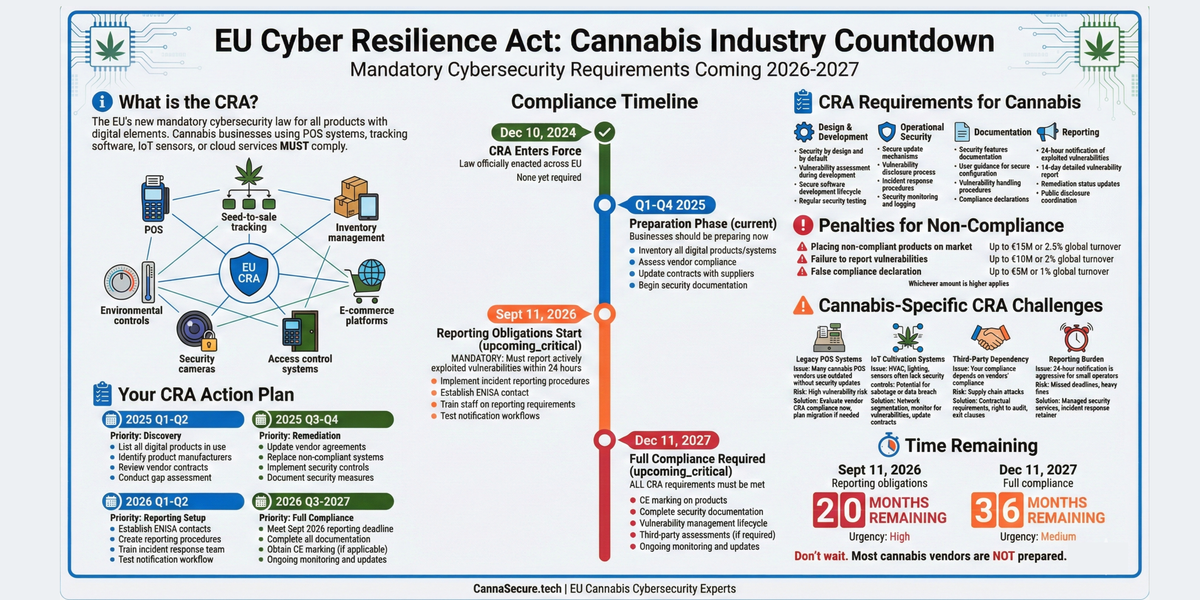
- Key Deadlines: September 11, 2026 (reporting obligations) | December 11, 2027 (full compliance)
- Applies To: All "products with digital elements" sold in the EU market
- Maximum Penalties: €15 million or 2.5% of global annual turnover
- Cannabis Impact: POS systems, seed-to-sale tracking, IoT sensors, HVAC controls, security systems
Introduction: The EU's New Mandatory Cybersecurity Law
On December 10, 2024, the European Union's Cyber Resilience Act (CRA) officially entered into force, marking the most sweeping mandatory cybersecurity regulation for digital products in EU history. Unlike sector-specific regulations, the CRA applies horizontally across all industries—including cannabis.
For cannabis businesses operating in or selling to European markets, this regulation represents both a significant compliance challenge and a potential competitive advantage. Companies that prepare now will be positioned as trusted partners for enterprise clients and government contracts. Those who ignore it risk substantial fines and market exclusion.
What is the Cyber Resilience Act?
The CRA (Regulation EU 2024/2847) establishes mandatory cybersecurity requirements for all "products with digital elements" sold on the EU market. This includes hardware, software, and their remote data processing solutions—covering everything from consumer IoT devices to industrial control systems.
The regulation requires:
- Security by design: Products must be developed with cybersecurity as a core requirement, not an afterthought
- Lifecycle security: Manufacturers must maintain security throughout the product's expected lifespan
- Vulnerability management: Active monitoring, disclosure, and patching of security vulnerabilities
- Incident reporting: Mandatory 24-hour reporting of actively exploited vulnerabilities to EU authorities
- CE marking: Products must display CE certification indicating CRA compliance
Why the CRA Affects Cannabis Businesses
Cannabis operations are increasingly technology-dependent. From seed-to-sale tracking mandated by regulators to environmental controls that optimize cultivation, digital systems permeate every aspect of the modern cannabis business. If you're operating in or selling products to EU markets, nearly every digital tool you use—or manufacture—falls under CRA scope.
The CRA doesn't care whether you're a cannabis-specific technology vendor or a general-purpose POS manufacturer who happens to have cannabis clients. If the product contains digital elements and reaches the EU market, compliance is mandatory.
Critical Deadlines
September 11, 2026 – Reporting Obligations Begin
From this date, manufacturers must report actively exploited vulnerabilities within 24 hours to the Computer Security Incident Response Team (CSIRT) of their member state and to the European Union Agency for Cybersecurity (ENISA). This applies to all products currently on the market—not just new releases.
December 11, 2027 – Full Compliance Required
All CRA requirements become enforceable. Products without CE marking indicating CRA compliance cannot be sold in the EU. This includes cybersecurity by design requirements, documentation, Software Bills of Materials (SBOMs), and ongoing vulnerability management.
Penalties for Non-Compliance
The CRA establishes a tiered penalty structure:
- Essential cybersecurity requirement violations: Up to €15 million or 2.5% of total worldwide annual turnover, whichever is higher
- Other CRA obligation violations: Up to €10 million or 2% of global annual turnover
- Providing incorrect information to authorities: Up to €5 million or 1% of global annual turnover
Beyond fines, non-compliant products can be banned from the EU market entirely, and market surveillance authorities can mandate product recalls.
Section 1: Does the CRA Apply to Your Cannabis Business?
The CRA's scope is intentionally broad, covering approximately 90% of digital products sold in the EU. Understanding whether—and how—the regulation applies to your business is the essential first step.
What are "Products with Digital Elements"?
The CRA defines a product with digital elements (PDE) as "any software or hardware product and its remote data processing solutions, including software or hardware components being placed on the market separately."
More specifically, PDEs include products "whose intended or reasonably foreseeable use includes a direct or indirect logical or physical data connection to a device or network."
In practical terms: if it connects to a network, receives updates, or processes data remotely, it's likely in scope.
Cannabis Industry Systems Covered by the CRA
Point-of-Sale (POS) Systems
Cannabis-specific POS platforms like Flowhub, Dutchie, or custom solutions are clearly within scope. These systems handle financial transactions, integrate with seed-to-sale tracking, and often connect to cloud backends—all characteristics that bring them under CRA jurisdiction.
Seed-to-Sale Tracking Software
Compliance tracking platforms mandated by regulators (METRC integrations, BioTrack, etc.) fall squarely within CRA scope. These systems maintain logical data connections and often process information remotely.
Inventory Management Systems
Any inventory management software that connects to networks or cloud services requires CRA compliance, whether cannabis-specific or general-purpose solutions adapted for the industry.
Environmental Control Systems
Climate control systems for cultivation facilities—HVAC, lighting automation, CO2 regulation, irrigation controllers—increasingly feature network connectivity and remote monitoring capabilities. IoT sensors measuring temperature, humidity, and soil conditions are explicitly targeted by the CRA.
Security Cameras and Access Control
IP-connected security cameras, badge access systems, and alarm monitoring platforms are all PDEs under the CRA. Given cannabis security requirements, these systems are ubiquitous in the industry.
E-Commerce Platforms
Online ordering systems, delivery management software, and customer-facing applications all fall within scope if they connect to networks or process data remotely.
Manufacturer vs. Distributor Obligations
The CRA establishes different obligations based on your role in the supply chain:
Manufacturers bear the primary compliance burden. They must ensure products meet essential cybersecurity requirements, conduct risk assessments, create technical documentation, provide SBOMs, and handle vulnerability reporting. If you develop cannabis technology in-house, you're a manufacturer.
Importers who bring products into the EU market must verify that manufacturers have fulfilled their obligations and that proper CE marking and documentation exist.
Distributors must verify that products bear the required CE marking and that manufacturers and importers have met their obligations. If you discover non-compliance, you cannot make the product available until issues are resolved.
Self-Assessment Checklist
Answer these questions to determine your CRA exposure:
- Do you manufacture, import, or distribute digital products in EU markets?
- Do any of your products connect to networks, receive updates, or process data remotely?
- Do you use third-party technology vendors for critical business systems?
- Do your technology vendors sell products in EU markets?
- Have your vendors communicated CRA compliance plans?
If you answered "yes" to questions 1-2, you have direct CRA obligations. If you answered "yes" to questions 3-5, you have supply chain risk that requires vendor assessment.
Section 2: CRA Security Requirements
The CRA establishes comprehensive cybersecurity requirements that apply throughout a product's lifecycle. Understanding these requirements is essential for both compliance planning and vendor evaluation.
Cybersecurity by Design and by Default
Products must be designed, developed, and produced to ensure an appropriate level of cybersecurity based on their risk profile. The CRA requires that products are delivered:
- Without known exploitable vulnerabilities
- With secure-by-default configurations
- With appropriate access controls and authentication mechanisms
- With encryption for data at rest and in transit using state-of-the-art mechanisms
- With integrity protection for stored and transmitted data
- With data minimization—collecting only necessary information
- With resilience against denial-of-service attacks
- With minimal attack surface exposure