
GDPR Compliance for Cannabis Dispensaries: The Complete 2025 Guide

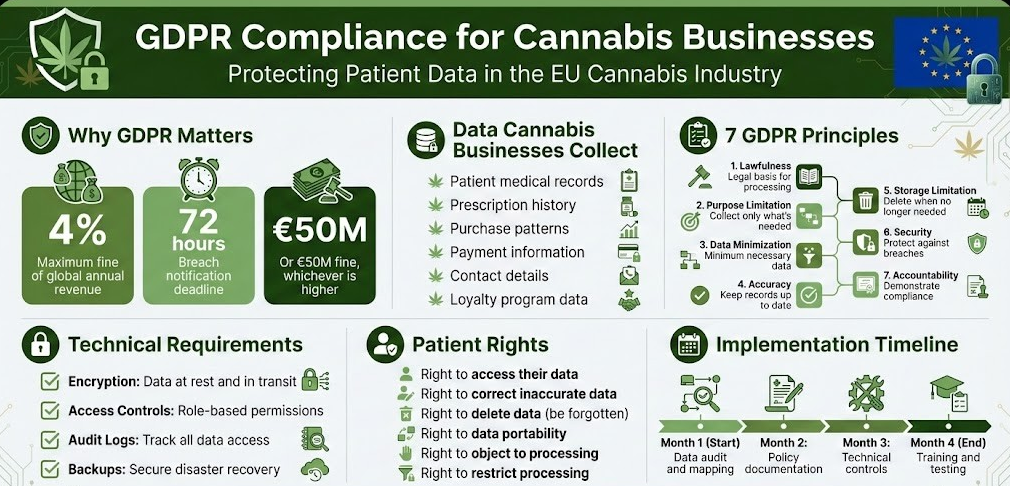
Your comprehensive roadmap to EU data protection compliance—before regulators come knocking
 Compliance Hub
The European cannabis industry is experiencing unprecedented growth. Germany legalized adult-use in April 2024, joining Malta and Luxembourg. Medical cannabis programs are expanding across France, Poland, and the UK. And as dispensaries scale operations across borders, they're collecting more sensitive personal data than ever before.
Here's the problem: cannabis businesses handle some of the most sensitive data categories under EU law, yet many operators treat GDPR compliance as an afterthought. That's a €20 million mistake waiting to happen.
In 2024 alone, European data protection authorities imposed €22.8 million in fines against healthcare-related businesses—pharmacies, hospitals, and medical suppliers. A Swedish pharmacy paid €3.2 million for improperly configured Meta Pixels that leaked customer data. An Estonian pharmacy loyalty program operator was fined €3 million after a breach exposed 750,000 customers' health-related purchase histories.
Cannabis dispensaries face even greater scrutiny. You're not just processing names and addresses—you're handling medical conditions, prescription histories, consumption patterns, and in some jurisdictions, data that could still carry criminal implications.
This guide breaks down exactly what GDPR means for cannabis operations, the specific requirements you must meet, and how to build a compliance program that protects both your customers and your business.
Introduction: Why Cannabis + GDPR = High Risk
The Stakes Are Real: 4% of Global Revenue
GDPR fines aren't theoretical. By January 2025, cumulative GDPR penalties exceeded €5.88 billion. The maximum fine structure is designed to hurt:
- Up to €20 million, or
- 4% of total worldwide annual turnover (whichever is higher)
For a cannabis operation generating €10 million annually, that's a potential €400,000 penalty for serious violations. For larger operators with cross-border presence, the exposure scales dramatically.
The enforcement trend is clear: regulators are moving beyond Big Tech. In 2024, authorities increasingly targeted healthcare, financial services, and retail sectors. Cannabis sits at the intersection of all three risk profiles.
Cannabis Businesses Handle Special Category Data
Under Article 9 of the GDPR, "data concerning health" receives the highest level of protection. This isn't limited to medical records. It includes:
- Purchase histories that reveal health conditions
- Prescription information for medical cannabis patients
- Consultation notes from in-store pharmacists or budtenders
- Delivery addresses for medical products
- Payment records linked to health purchases
When a customer buys CBD oil for anxiety or THC products for chronic pain management, you're processing health data—whether you realize it or not.
Regulatory Scrutiny Is Higher Than Other Industries
Cannabis businesses operate under a microscope. National drug enforcement agencies, financial regulators, and public health authorities already monitor the industry closely. Data protection authorities recognize that cannabis customers may face:
- Social stigma if their purchases become public
- Employment consequences in certain sectors
- Insurance implications for health and life coverage
- Legal exposure in jurisdictions with stricter laws
This heightened sensitivity means regulators are less likely to accept "we didn't know" as an excuse. The reputational and legal exposure for your customers compounds your compliance obligations.
Section 1: What GDPR Means for Cannabis Operations
GDPR applies to any organization that processes personal data of individuals located in the European Economic Area (EEA), regardless of where the business is headquartered. If you serve EU customers—whether from a storefront in Amsterdam, an online pharmacy in Germany, or a cultivation facility shipping to distributors across Europe—you're subject to these rules.
Patient and Customer Data You're Collecting
Most dispensaries collect far more data than they realize. A comprehensive data audit typically reveals:
At Point of Sale:
- Full legal names and ID verification documents
- Dates of birth (age verification requirements)
- Physical addresses for delivery or registration
- Email addresses and phone numbers
- Purchase histories and product preferences
- Payment card data and transaction records
- Loyalty program participation and rewards balances
For Medical Cannabis Patients:
- Medical cannabis authorizations or prescriptions
- Prescribing physician information
- Qualifying medical conditions
- Dosage recommendations and consumption guidance
- Consultation notes from pharmacists or healthcare staff
- Renewal dates and prescription validity periods
Through Digital Channels:
- Website browsing behavior and session data
- IP addresses and device identifiers
- Account credentials and login histories
- Customer service chat logs and email correspondence
- Marketing preferences and opt-in records
Employee Data Obligations
Your GDPR responsibilities extend to your workforce. Cannabis businesses must protect:
- Employment contracts and HR records
- Background check results (particularly sensitive given industry regulations)
- Health and safety training records
- Timekeeping and payroll data
- Performance reviews and disciplinary records
- Security clearance documentation
Many cannabis licenses require operators to maintain detailed employee records for regulatory compliance. These retention requirements create tension with GDPR's data minimization principle—a conflict we'll address in Section 3.
Vendor and Supplier Data Processing
Your supply chain generates personal data obligations:
- Cultivation facility contact information
- Testing laboratory personnel data
- Distribution partner records
- Payment and banking contact details
- Compliance officer information for licensed partners
When you share customer data with vendors—for delivery services, payment processing, or marketing platforms—you become responsible for ensuring those vendors meet GDPR standards.
Marketing Data: Email Lists and Retargeting
Cannabis marketing faces unique restrictions, but compliant operators still build customer relationships through:
- Email newsletter subscribers
- SMS marketing lists
- Social media audience data (where platforms permit cannabis content)
- Retargeting pixels and advertising cookies
- Referral program participant information
Each of these data streams requires explicit legal basis, clear consent mechanisms, and documented processing purposes. The Swedish pharmacy cases demonstrate that improperly configured marketing technology can trigger multi-million euro fines.
Section 2: The 7 GDPR Principles Cannabis Businesses Must Follow
Article 5 of the GDPR establishes seven foundational principles. Violations of these principles attract the highest tier of administrative fines. Every cannabis operation must embed these requirements into daily practice.
1. Lawfulness, Fairness, and Transparency
You must have a valid legal basis for every data processing activity, treat individuals fairly, and be completely transparent about what you do with their information.
For cannabis dispensaries, this means:
- Clearly explaining why you collect each piece of data before collection occurs
- Publishing accessible, plain-language privacy notices
- Never processing data in ways customers wouldn't reasonably expect
- Providing information about data processing in the customer's language
- Avoiding deceptive practices like pre-ticked consent boxes
Legal bases available for cannabis operations:
- Consent (Article 6(1)(a)): The customer explicitly agrees to specific processing
- Contract performance (Article 6(1)(b)): Processing necessary to fulfill a purchase or service agreement
- Legal obligation (Article 6(1)(c)): Required by law (license reporting, tax records)
- Legitimate interests (Article 6(1)(f)): Business purposes that don't override customer rights
For health data under Article 9, you'll typically need explicit consent or must fall under the healthcare provision exception—which requires processing under the responsibility of a health professional bound by confidentiality obligations.