Seed-to-Sale Tracking: The Hidden Privacy Trade-Offs in Cannabis Surveillance

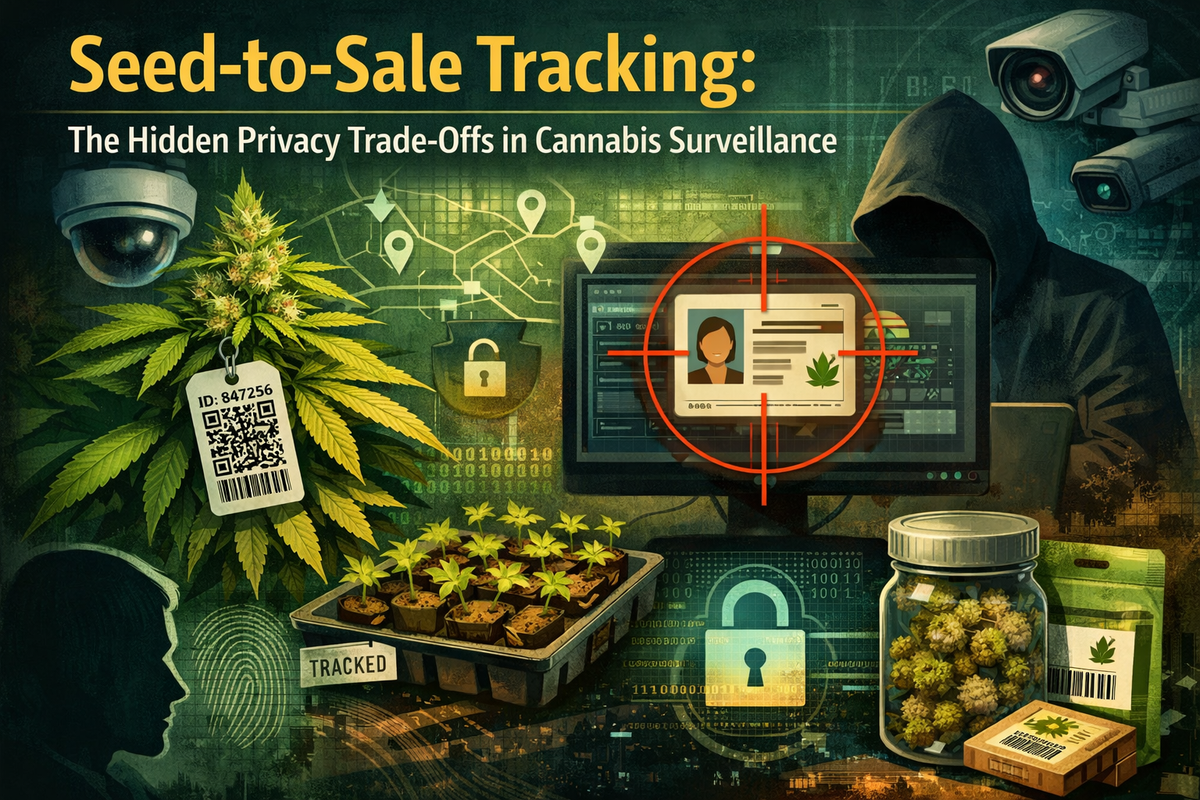
Every cannabis plant and product in legal states is tracked from germination to your pocket. Here's what that means for privacy, security, and compliance—and why you should care.
Walk into a legal cannabis dispensary anywhere in the United States, and you're entering one of the most surveilled retail environments in the world.
Every product on the shelf has been tracked through its entire lifecycle. Every plant that produced that flower was individually monitored. Every gram has been weighed, tested, documented, and reported to state regulators in real-time.
This comprehensive surveillance system is called "seed-to-sale" tracking—and it's mandatory in every legal cannabis state.
But here's what most consumers don't realize: the technology designed to prevent illegal diversion also creates a massive digital trail of sensitive data about growers, dispensaries, employees, and yes—you, the customer.
So let's talk about what seed-to-sale tracking actually is, how the technology works, what data is being collected, who has access to it, and what the privacy implications really mean.
What is Seed-to-Sale Tracking?
Seed-to-sale tracking (also called "track-and-trace") is a government-mandated compliance system that monitors cannabis products throughout their entire lifecycle:
- Seed/Clone → Planted
- Vegetative Growth → Tracked as immature plant
- Flowering → Tagged with RFID or barcode
- Harvest → Weighed, batched, packaged
- Testing → Lab analysis recorded
- Processing → Manufacturing into products
- Distribution → Transfer to dispensaries
- Sale → Transaction logged
- End Consumer → You
At every stage, hundreds of data points are captured and reported to state regulatory agencies.
Why Does Seed-to-Sale Tracking Exist?
Three primary goals:
1. Prevent Diversion to the Black Market
Regulators want to ensure that legal cannabis stays in the legal market and doesn't leak into illegal channels.
By tracking every plant and product, states can theoretically account for every gram grown, sold, or destroyed.
2. Tax Collection
States collect hundreds of millions in cannabis tax revenue annually. Seed-to-sale systems ensure accurate reporting so states can verify sales and collect taxes owed.
3. Public Safety & Product Quality
Tracking systems enable:
- Product recalls (if contaminated products need to be pulled)
- Testing verification (confirming products passed safety tests)
- Age verification enforcement (preventing sales to minors)
The Technology Behind Seed-to-Sale
RFID Tags: The Backbone of Cannabis Surveillance
Most seed-to-sale systems use RFID (Radio Frequency Identification) technology.
How RFID works:
- Each plant receives an RFID tag (a small chip embedded in a label)
- The tag contains a unique identifier (UID) linked to that specific plant
- Tags are scanned using handheld readers or fixed scanners
- Data is transmitted wirelessly to the tracking software
- Information syncs in real-time with state databases
Two types of RFID tags:
Plant Tags (larger, more expensive):
- Applied when plants exceed "immature" status (typically 8" tall)
- Track plant through vegetative growth, flowering, harvest
- Yellow tags = medical cannabis
- Blue tags = retail/recreational cannabis
Package Tags (smaller, cheaper):
- Applied to harvested batches and manufactured products
- Track packages through testing, processing, distribution, sale
Cost:
- Plant tags: $0.60-$0.80 each
- Package tags: $0.25-$0.40 each
- A large cultivation facility with 10,000 plants spends $6,000-$8,000 on tags alone
The Major Seed-to-Sale Platforms
43 states and territories with legal cannabis use four main systems:
Metrc (~50% market share)
- Used in 24+ states (Colorado, California, Michigan, Nevada, etc.)
- Owned by Franwell Inc. (now part of BT Government)
- RFID-based tracking
- State-contracted system (mandatory for licensees)
BioTrack (~24% market share)
- Used in New York, Connecticut, New Mexico, others
- Recently partnered with Metrc (August 2025)
- Many BioTrack states may transition to Metrc infrastructure
Leaf Data Systems (~6% market share)
- Used in Washington state
- State-owned system
Trace (smaller share)
- Used in select states
Key point: These are state-mandated systems. Cannabis businesses don't choose which platform to use—the state chooses for them.
What Data is Collected?
Here's what seed-to-sale systems track:
Plant-Level Data:
- Unique plant ID
- Strain/genetics
- Planting date
- Growth phase (vegetative, flowering)
- Physical location in facility
- Mother plant origin
- Destruction/waste date (if applicable)
Harvest Data:
- Harvest date
- Wet weight
- Dry weight
- Assigned package UID
- Employee who performed harvest
- Waste material weight
Processing Data:
- Manufacturing method (extraction, infusion, etc.)
- Input materials (flower, trim, etc.)
- Output products (concentrates, edibles, etc.)
- Equipment used
- Batch numbers
- Employee performing processing
Testing Data:
- Lab name
- Test batch creation
- Potency results (THC, CBD percentages)
- Contaminant testing (pesticides, heavy metals, microb
ials)
- Moisture content
- Pass/fail status
- Testing date
Transfer Data:
- Manifest number
- Originating license
- Receiving license
- Transporter information
- Vehicle identification
- Departure time
- Arrival time
- Product quantities
Retail Sale Data:
- Transaction ID
- Date and time of sale
- Product(s) sold
- Quantities
- Prices
- Employee who made sale
- Customer information (varies by state)
This is where privacy gets complicated.
Customer Privacy: What Dispensaries Know About You
For Recreational/Adult-Use Purchases:
Minimum Required:
- ID verification (proving you're 21+)
- Most states require ID scan at door
- Information captured: Name, date of birth, ID number, photo
Optional (depends on dispensary):
- Loyalty program enrollment (email, phone, purchase history)
- Marketing opt-ins
- Product preferences
Critical distinction: Recreational sales generally do NOT require customer data to be reported to state seed-to-sale systems.
The dispensary logs the transaction (product, quantity, price) but not your personal identity in state databases.
However:
- Your information is still in the dispensary's POS system
- Dispensaries are targets for hackers (high-value customer data)
- No federal banking = often less sophisticated cybersecurity
For Medical Cannabis Purchases:
This is where HIPAA gets complicated.
Medical dispensaries collect significantly more data:
- Patient name
- Medical marijuana card number
- Date of birth
- Address
- Photo
- Medical condition/diagnosis (in some states)
- Physician recommendation
- Purchase history (products, dosages)
- Allotment limits (how much you can purchase per month)
Is this protected by HIPAA?
The short answer: It depends.
HIPAA (Health Insurance Portability and Accountability Act) protects "protected health information" (PHI) but only applies to "covered entities":
- Hospitals
- Doctors
- Health insurance companies
- Healthcare clearinghouses
Are medical dispensaries covered entities?
Legally ambiguous.
Arguments FOR HIPAA applying:
- Dispensaries provide medical treatment (cannabis as medicine)
- They collect PHI (diagnosis, treatment information)
- Some states (Illinois, for example) explicitly require dispensaries to comply with HIPAA
Arguments AGAINST HIPAA applying:
- Dispensaries don't submit electronic insurance claims (because insurance doesn't cover cannabis)
- Without electronic claims, they're not "covered entities" under HIPAA's technical definition
- Federal law doesn't recognize cannabis as medicine (Schedule I status—now changing with Schedule III)
Practical reality:
Most medical dispensaries act as if HIPAA applies because:
- It's good practice
- State regulators may require it
- Data breaches = lawsuits regardless of HIPAA status
- Customer trust depends on privacy protection
Key HIPAA-style protections (if applied):
- Encryption of patient records
- Access controls (only authorized employees can view PHI)
- Audit logs (tracking who accessed what data)
- Breach notification (patients notified if data is compromised)
- Minimum necessary disclosure (only share data required for task)
- Patient authorization (written consent to share data)
State Privacy Laws (Beyond HIPAA)
Even if HIPAA doesn't apply, 17 states now have comprehensive privacy laws that regulate how businesses collect, use, and disclose personal information:
- California: CCPA (California Consumer Privacy Act)
- Washington: My Health My Data Act (specifically covers health data, including cannabis purchases)
- Virginia, Colorado, Connecticut, Utah, and others
Washington's My Health My Data Act is particularly relevant:
- Covers any business that collects health information
- Cannabis purchases that "identify the consumer's past, present, or future physical or mental health status" = covered
- Creates private right of action (consumers can sue for violations)
- Strict requirements: data minimization, explicit consent, vendor management
Translation: Even recreational dispensaries in Washington must treat customer data like health information.
Who Has Access to Seed-to-Sale Data?
State Regulators
Full access to:
- All plant tracking data
- All transfer manifests
- All sales transactions
- Inventory levels
- Testing results
What they see:
- Which businesses are operating
- How much product is moving through the supply chain
- Whether inventory matches sales
- Compliance violations (missing tags, inventory discrepancies, failed tests)
What they (usually) don't see:
- Individual customer identities (for recreational sales)
- Medical patient diagnoses (in most states)
Law Enforcement
Access varies by state.
Some states grant law enforcement direct access to seed-to-sale databases for:
- Investigating illegal diversion
- Tracking criminal activity
- Compliance inspections
Other states require warrants or subpoenas for law enforcement to access specific records.
Critical concern: Law enforcement access to cannabis purchase data could be used to:
- Profile individuals
- Build cases for other offenses
- Cross-reference with other databases
Example concern: Federal law enforcement accessing state databases during federal crackdowns (unlikely under current policy, but legally possible).
Cannabis Businesses
Access to their own data:
- Cultivation facilities see their plants, harvests, transfers
- Manufacturers see their production batches, inventory
- Dispensaries see their sales, inventory, customer data (POS level)
Cannot access:
- Other businesses' data
- Customer data (except their own)
- Full supply chain beyond direct transfers
Third-Party Vendors (POS Systems, ERPs)
Cannabis businesses use third-party software to manage operations:
- Point-of-sale (POS) systems (Dutchie, Flowhub, Treez, etc.)
- Enterprise resource planning (ERP) platforms
- Inventory management software
- Customer loyalty programs
These vendors have access to:
- All data entered into their systems
- Customer purchase history
- Business financials
- Inventory levels
Risk: Vendor data breaches = your data compromised.
2020 THSuites Breach:
- POS software used by dispensaries
- 85,000 files exposed
- Included patient names, medical ID numbers, cannabis varieties purchased, quantities
This is why vendor security matters.
Privacy Risks: What Could Go Wrong?
1. Data Breaches (Hacking)
Cannabis businesses are attractive targets:
- High-value customer data (health information)
- Cash-heavy operations (financial data)
- Often lack sophisticated cybersecurity (no traditional banking = fewer security resources)
Consequences of breach:
- Customer medical information exposed
- Purchase history leaked
- Identity theft risk
- Loss of customer trust
2. Government Surveillance Overreach
Seed-to-sale systems create comprehensive databases of:
- Who is growing cannabis
- Who is selling cannabis
- Who is buying cannabis (in some cases)
Concern: What if federal policy changes?
- Could federal agencies access state databases?
- Could purchase data be used for federal prosecution?
- What happens if Schedule III creates new federal oversight?
Current reality: Federal government has generally respected state cannabis programs (hands-off approach since Obama-era Cole Memo)
But: Policy could change with new administration or enforcement priorities.
3. Employer Discrimination
Scenario: Employer subpoenas dispensary records during lawsuit or investigation.
Could your cannabis purchases be used against you?
- Employment termination (even in legal states, many employers have drug-free policies)
- Professional licensing consequences (pilots, CDL drivers, healthcare workers)
- Custody battles (cannabis use as factor in parenting)
Legal protections vary:
- Some states prohibit employment discrimination for off-duty legal cannabis use
- Others offer no protection
- Federal employees: cannabis use still prohibited
4. Insurance Implications
Health insurance:
- Could insurers access cannabis purchase data?
- Could they use it to deny claims or increase premiums?
Current status: Generally no (HIPAA protects medical records from insurers if cannabis use is documented by doctor)
But: Insurance companies increasingly use data brokers to profile customers.
Life insurance:
- Some insurers ask about cannabis use on applications
- Lying on application = fraud (policy void)
- Accurate disclosure may increase premiums
5. Lack of Standardized Security
No federal standard for cannabis data protection means:
- Security practices vary wildly by state
- Some states mandate encryption, others don't
- Vendor security requirements differ
- Enforcement inconsistent
How Seed-to-Sale Systems Could Be More Private
1. Data Minimization
Collect only what's necessary:
- State regulators need plant tracking for diversion prevention
- State regulators don't need customer identity for recreational sales
- Medical dispensaries should collect minimum diagnosis information
Best practice: Anonymize customer data in state reporting (track transaction, not identity).
2. Encryption Standards
Mandate encryption:
- Data at rest (stored in databases)
- Data in transit (transmitted between systems)
- End-to-end encryption for sensitive PHI
Current status: Some seed-to-sale systems (like Metrc) use AES-256 encryption, but not all states mandate this.
3. Access Controls & Audit Logging
Limit who can access data:
- Role-based permissions (budtenders shouldn't see all customer data)
- Multi-factor authentication for system access
- Comprehensive audit logs (tracking who accessed what, when)
Transparency: Customers should be able to request logs showing who accessed their data.
4. Automatic Data Deletion
Retention limits:
- Customer purchase history should be automatically purged after X months/years
- Medical information shouldn't be stored indefinitely
Current practice: Many dispensaries retain data indefinitely (for business analytics, loyalty programs)
Better practice: State-mandated retention limits (e.g., 3 years max)
5. Consumer Data Rights
Give customers control:
- Right to access: See what data is stored
- Right to correction: Fix inaccurate information
- Right to deletion: Request data removal
- Right to opt-out: Decline marketing, loyalty programs
Models: California CCPA, EU GDPR provide frameworks.
6. Blockchain Alternative?
Some propose blockchain-based seed-to-sale tracking:
Potential benefits:
- Decentralized (no single point of failure)
- Immutable (tamper-proof record)
- Transparent (visible audit trail)
- Pseudonymous (can separate business identity from tracking)
Challenges:
- Expensive to implement
- Requires significant infrastructure
- States already invested in existing systems
- Regulatory acceptance uncertain
What You Can Do to Protect Your Privacy
For Consumers:
1. Understand Your State's Laws
- Does your state mandate customer data reporting?
- What privacy protections exist?
- Can you request data deletion?
2. Minimize Data Sharing
- Don't enroll in loyalty programs unless you trust the dispensary's security
- Avoid providing email/phone unless necessary
- Use cash when possible (credit card creates additional data trail)
3. Ask Questions
- "What data do you collect?"
- "How is it stored and protected?"
- "Who has access?"
- "How long do you retain it?"
- "Can I request deletion?"
4. Choose Reputable Dispensaries
- Look for HIPAA compliance (medical dispensaries)
- Check if they encrypt customer data
- Verify they use secure POS systems
- Read privacy policies
5. Consider Anonymity (Legal Caution)
- Some customers use prepaid cards to avoid credit card records
- Some avoid loyalty programs entirely
- Note: Fake IDs or lying about identity = illegal
For Cannabis Businesses:
1. Implement Strong Cybersecurity
- Encrypt all customer data
- Use secure POS systems
- Regular security audits
- Employee training (phishing, social engineering)
2. Data Minimization
- Collect only necessary information
- Don't require email/phone for simple transactions
- Anonymize data where possible
3. Transparency
- Clear privacy policies
- Inform customers what data you collect and why
- Provide opt-out options
4. Vendor Due Diligence
- Vet third-party software providers
- Require vendor security certifications
- Contractual data protection requirements
- Business Associate Agreements (if HIPAA applies)
5. Incident Response Plan
- Procedures for data breaches
- Customer notification protocols
- State regulator reporting
- Legal counsel engagement
The Future of Seed-to-Sale Tracking
Trends to Watch:
1. Schedule III Impact
With cannabis moving to Schedule III:
- Will FDA oversight require pharmaceutical-level data tracking?
- Could federal agencies demand access to state databases?
- Will research use require enhanced privacy protections?
2. Interstate Commerce
If interstate commerce becomes legal:
- Federal tracking system likely required
- Unified national database?
- Standardized privacy protections across states?
3. IoT & Automation
Advanced sensors and IoT devices will enable:
- Automated environmental monitoring (temperature, humidity)
- Real-time plant health tracking
- Predictive analytics
Privacy concern: More data = more risk.
4. AI & Predictive Analytics
State regulators may use AI to:
- Detect inventory anomalies
- Predict diversion risk
- Identify compliance violations
Consumer impact: Behavioral profiling of businesses (and potentially customers).
5. Biometric Security
Some states considering:
- Fingerprint scanning for customer age verification
- Facial recognition at dispensary entrances
- Iris scanning for employee access
Privacy advocates: Strongly opposed (permanent biometric data collection).
The Bottom Line: Privacy vs. Compliance
Seed-to-sale tracking is here to stay.
It serves legitimate purposes:
- Preventing illegal diversion
- Ensuring product safety
- Collecting tax revenue
But it also creates unprecedented surveillance of a legal industry and its customers.
The question isn't whether to track—it's how to track responsibly.
What responsible tracking looks like:
- Data minimization (collect only what's necessary)
- Strong encryption (protect what's collected)
- Access controls (limit who can see it)
- Transparency (tell people what you're doing)
- Consumer rights (let people control their data)
As a consumer, you have a right to know:
- What data is collected about your cannabis purchases
- How it's protected
- Who has access
- How long it's retained
As a cannabis business, you have a responsibility to:
- Protect customer data like the valuable asset it is
- Comply with privacy laws (HIPAA where applicable, state privacy laws)
- Implement robust cybersecurity
- Earn customer trust through transparency
The cannabis industry is one of the most heavily regulated and surveilled industries in the world.
That doesn't mean privacy has to be sacrificed.
It just means we need to be intentional about building privacy protections into the technology from day one—not as an afterthought.
Related Reading:
- HIPAA Compliance for Medical Dispensaries: A Complete Guide
- How to Audit Your Dispensary's Cybersecurity
- Cannabis Customer Data: What Can Employers Access?
- State-by-State Cannabis Privacy Laws (2025)