The Cannabis Policy Problem Nobody Talks About (And Three Tools That Actually Solve It)

The $380,000 Question
When STIIIZY suffered a data breach affecting 380,000 customers in 2024, the investigation revealed something more troubling than the breach itself: they had cybersecurity policies in place, but those policies hadn't been updated in over two years.
Their documented "incident response plan" referenced systems they'd replaced 18 months prior. Their "data protection policy" didn't account for the new POS integration they'd launched. Their vendor security requirements existed on paper—but the vendor who caused the breach had never actually been assessed against them.
STIIIZY isn't alone. This is the hidden crisis in cannabis cybersecurity: it's not that businesses don't have policies—it's that those policies are abandoned the moment they're created.
 CannaSecure
The Cannabis Policy Lifecycle Problem
Cannabis businesses face unique compliance pressures that make policy management exponentially harder than traditional industries:
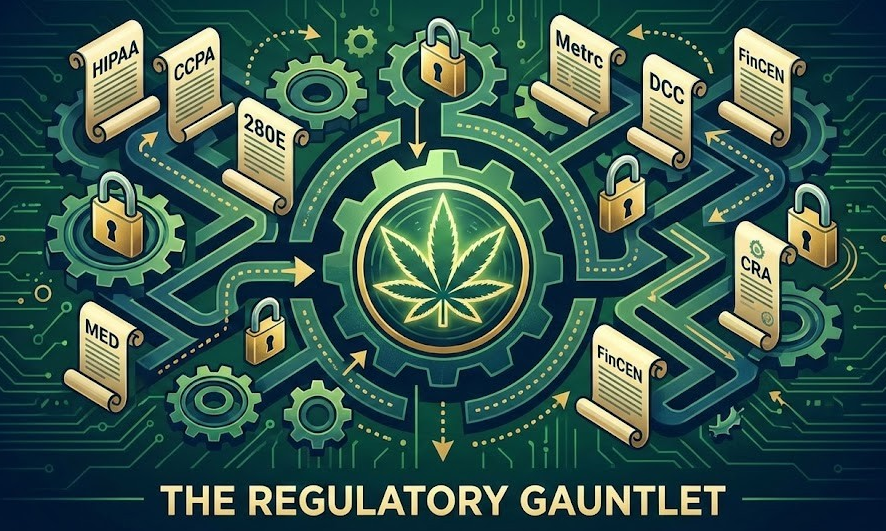
The Regulatory Gauntlet
Unlike typical businesses that answer to one or two regulatory frameworks, cannabis operators navigate a labyrinth:
- State cannabis regulations (varies by state: California DCC, Michigan CRA, Colorado MED, etc.)
- HIPAA compliance (for medical dispensaries handling patient data)
- State privacy laws (CCPA, CPRA, CPA, VCDPA, and counting)
- Financial compliance (280E restrictions, FinCEN guidance, banking limitations)
- Physical security mandates (video retention, access control, alarm systems)
- Seed-to-sale tracking (Metrc, BioTrack, state-specific platforms)
- Cybersecurity frameworks (increasingly required: documented information security policies)

Illinois now requires documented cybersecurity policies as part of cannabis licensing. Pennsylvania mandates four-year video retention with documented access controls. Connecticut requires security to integrate with seed-to-sale tracking systems.
The problem: Policies written to satisfy one requirement quickly become obsolete as regulations shift, technology changes, or business operations evolve.
The Three Failure Points
Cannabis policy management fails at three critical junctures:
1. The Creation Crisis
Most cannabis businesses approach policy creation in one of three ways:
Option A: The Template Trap
Download generic templates from the internet. Fill in your business name. Submit to regulators. These policies:
- Use language from other industries (manufacturing, retail, healthcare)
- Don't address cannabis-specific threats (cash handling, seed-to-sale security, cultivation facility access)
- Miss state-specific requirements (video retention periods, alarm specifications, badging systems)
- Create compliance liability when auditors discover they don't match actual practices
Option B: The Consultant Gamble
Hire a consultant at $5,000-$15,000 to create "custom" policies. You get:
- A beautiful binder of policies
- Editable Word documents
- Zero understanding of how to maintain them
- No way to update policies when regulations change or you implement new technology
Option C: The DIY Death March
Spend 40+ hours researching frameworks, trying to write policies from scratch. You:
- Research NIST, CIS, ISO 27001 trying to figure out what applies to cannabis
- Struggle with technical language ("implement multi-factor authentication for all privileged accounts")
- Create policies that sound good but don't map to your actual operations
- Abandon the effort halfway through and submit incomplete documentation
The result: Policies exist, but they're either:
- Generic and non-compliant
- Expensive and unchangeable
- Incomplete and abandoned
2. The Maintenance Gap
States like New Jersey, Massachusetts, and Michigan have shown that robust workforce standards reduce violations across the board. But those standards change constantly.
Consider what's changed in cannabis compliance over just the last 18 months:
- Cybersecurity mandates: More state-level requirements for documented information-security policies, vendor risk assessments, clear internal controls around customer and patient data
- Environmental requirements: New sustainability tracking, waste management documentation
- Workforce compliance: Expanded badging systems, impairment policies, access-control enforcement
- Data security: Encryption requirements, incident response timelines, breach notification rules
Real scenario from a Michigan dispensary (client, anonymized):
- January 2024: Passed state audit with compliant policies
- March 2024: Launched new online ordering system (policies never updated to reflect new data flows)
- June 2024: Michigan updated cybersecurity requirements (policies not revised)
- September 2024: Hired new IT vendor (never assessed against vendor security policy)
- November 2024: Failed surprise audit—policies no longer matched operations
The maintenance gap kills compliance. Policies become "write once, ignore forever" documents that create liability instead of protection.
3. The Integration Failure
Even when cannabis businesses create good policies and maintain them, they fail to integrate policies into daily operations.
What happens in practice:
- Incident response plan exists → Nobody knows where it is during actual breach
- Access control policy documented → Badges still shared between employees
- Vendor security requirements written → New POS system implemented without security review
- Employee training policy approved → Onboarding skips cybersecurity completely
- Data retention policy filed → Surveillance footage deleted too early, violating state mandates
The failure point: Policies live in a compliance binder, disconnected from the business systems (HR onboarding, vendor management, IT change control) where they need to be enforced.


Why Cannabis Can't Afford the Policy Failure
The cannabis industry faces disproportionate consequences when policy management fails:
Financial Penalties Stack
Unlike traditional industries where one regulator might fine you, cannabis businesses face layered penalties:
- State cannabis licensing: License suspension, daily fines, revocation threats
- HIPAA violations (medical dispensaries): $100 to $50,000 per violation, up to $1.5M annual maximum
- State privacy laws: California CCPA fines up to $7,500 per violation
- Data breach costs: The global average cost of a data breach is $4.44 million, with U.S. breaches averaging over $10 million per incident
Compounding effect: A single security incident can trigger violations across multiple regulatory frameworks simultaneously.
License Vulnerability
Cannabis licenses aren't just revenue sources—they're existential. You can't pivot to another state or "just pay the fine."
Real penalties from inadequate security documentation:
- Colorado (2023): Cultivation facility lost license after audit revealed security policies didn't match actual video surveillance configuration
- California (2024): Dispensary fined $50,000 for failing to maintain documented employee training records required by security plan
- Michigan (2025): Multi-site operator placed on provisional license status after unannounced inspection found outdated incident response procedures
The stakes: Unlike other industries where compliance failures result in fines, cannabis businesses risk losing the license itself.
Cyber Insurance Requirements
Cannabis businesses don't get many options when it comes to cyber insurance providers, so it's important to put our best foot forward when seeking or renewing cyber insurance policies.
What insurers now require:
- Documented information security policies (not templates—actual policies reflecting your environment)
- Evidence of policy enforcement (training records, audit logs, access reviews)
- Incident response plans that have been tested
- Vendor security assessments
- Regular policy updates (insurers check last-modified dates)
Failure to maintain policies = no insurance or drastically higher premiums.
Operational Chaos
Beyond regulatory and financial risks, policy failure creates operational dysfunction:
- Employee confusion: "Should I share my badge?" "Can I access customer data from home?" "What do I do if POS system goes down?"
- Vendor disputes: No documented security requirements = no leverage when vendors cause breaches
- Incident paralysis: Breach occurs, nobody knows notification timelines or who to call
- Technology debt: Systems implemented without security review accumulate vulnerabilities
The hidden cost: Firefighting compliance issues instead of growing the business.

The Three Tools That Actually Solve This
The cannabis policy lifecycle problem requires purpose-built solutions—not adapted from other industries, not generic templates, not expensive consultants. You need tools that:
- Create cannabis-specific policies quickly
- Make maintenance systematic instead of heroic
- Integrate policies into actual business operations
Here are three tools from the QSai ecosystem designed specifically for this problem:
Tool #1: PolicyQuest.DIY - The Cannabis Policy Generator
What it solves: The Creation Crisis
How it works:
PolicyQuest.DIY is a guided policy creation platform specifically for cannabis businesses. Instead of templates or consultants, you:
- Select your policy type: Information Security, Incident Response, Access Control, Vendor Security, Data Protection, etc.
- Answer cannabis-specific questions:
- State(s) of operation (auto-populates state requirements)
- Facility type (dispensary, cultivation, manufacturing, testing)
- Technology stack (POS system, seed-to-sale platform, video surveillance)
- Regulatory frameworks (medical vs. adult-use, HIPAA applicability)
- Get generated policy: Context-aware, cannabis-compliant, customized to your operations
- Export ready-to-use formats: PDF, Word (editable), Markdown
Cannabis-specific advantages:
- State-aware: Automatically includes Pennsylvania's 4-year video retention if you're in PA, Illinois cybersecurity mandates if you're in IL
- Framework-mapped: Policies reference specific state regulations and seed-to-sale requirements
- Integration-ready: Policies include implementation checklists and training templates
Cost: FREE tier for 3 policies/month; Pro tier at $29/month for unlimited generation
💰 Special pricing for cannabis operators: Use code CISO20 for 20% OFF site-wide
Use case: Michigan dispensary generated complete policy suite (10 policies) in 2 hours vs. 6 weeks DIY or $8,000 consultant engagement
👉 Generate your first cannabis policy free at PolicyQuest.DIY →
Tool #2: GeneratePolicy.com - The Compliance Accelerator
What it solves: The Maintenance Gap + Creation Crisis
How it works:
GeneratePolicy.com goes beyond basic policy creation to solve policy maintenance with:
Smart Templates:
- Cannabis industry frameworks (not generic IT policies adapted from banking)
- Version control built-in (track what changed, when, why)
- Regulatory change alerts (notifies when state requirements update)
Maintenance Automation:
- Annual review reminders
- Gap analysis tools (compare your policies to current requirements)
- Bulk update capabilities (need to add new POS system across all policies? Update once, cascade everywhere)
Compliance Bundles:
Get complete policy suites for specific cannabis operations:
- Dispensary Starter: 7 essential policies (access control, incident response, data protection, vendor security, employee training, video surveillance, cash handling)
- Medical Compliance: Adds HIPAA policies, patient data protection, health information security
- Multi-State Operator: State-specific policy variations, centralized maintenance, audit-ready documentation
Cannabis-specific advantages:
- Regulatory tracking: Monitors 33 medical cannabis states + 24 adult-use states for policy-relevant changes
- Seed-to-sale integration: Policies specifically address Metrc, BioTrack, and state tracking systems
- Audit preparation: One-click compliance reports mapping your policies to state requirements
Cost: Policy bundles from $149-$499; subscription plans from $49/month
💰 Cannabis operator pricing:
- First-time buyers: Use code
CISO30for 30% OFF (expires 2026-12-31) - CISO Marketplace members: Use code
CISO15for 15% OFF ongoing
Use case: California multi-site operator (4 locations) uses GeneratePolicy.com to maintain consistent policies across all sites, updated quarterly as regulations evolve
👉 Browse cannabis policy bundles at GeneratePolicy.com →
Tool #3: CyberTemplates.com - The Integration Layer
What it solves: The Integration Failure
How it works:
CyberTemplates.com bridges the gap between policy documents and operational reality with:
Operational Templates:
- HR onboarding checklists (ensures new employees get cybersecurity training per policy)
- Vendor security questionnaires (implements your vendor security policy in practice)
- Incident response runbooks (policy becomes action: "Breach detected. Step 1...")
- Audit preparation guides (maps policies to required evidence)
Implementation Tools:
- Access control audit templates (verify badge policy enforcement)
- Training documentation (proves you're following employee security policy)
- Change management forms (ensures new technology reviewed against security policies)
Cannabis-specific templates:
- Dispensary Security Checklists: Opening/closing procedures, cash handling protocols, video surveillance verification
- Cultivation Access Control: Facility entry logs, restricted area management, visitor tracking
- Compliance Audit Prep: State inspector readiness, documentation verification, policy-to-practice mapping
- Incident Response Playbooks: Data breach notification (state-specific), ransomware response, POS compromise procedures
Integration advantages:
- Policy-linked: Every template references the specific policy it implements
- State-specific: Checklists adapt to state requirements (Michigan unannounced inspections, Pennsylvania audit procedures)
- Evidence generation: Creates the documentation auditors request ("show me proof you're following your incident response policy")
Cost: Individual templates from $19-$49; bundles from $99-$249; subscription at $39/month
💰 Cannabis operator pricing:
- First-time subscriptions: Use code
CISO30for 30% OFF (one-time use, expires 2026-12-31) - Token packages: Use code
CISO20for 20% OFF forever
Use case: Colorado dispensary failed audit due to gap between policy and practice. Used CyberTemplates.com implementation tools, passed follow-up audit 90 days later with documented evidence of policy enforcement.
👉 Get cannabis cybersecurity templates at CyberTemplates.com →

Special Offer: CISO Marketplace Ecosystem Deals for Cannabis Operators
Thanks to our partnership with CISO Marketplace, cannabis security professionals get exclusive access to ecosystem-wide deals across all our policy and security tools.
🎁 Active Cannabis Security Deals (View all deals)
Policy Creation & Management:
PolicyQuest.DIY
CISO20- 20% OFF site-wide savings- → Generate cannabis policies
GeneratePolicy.com
CISO30- 30% OFF for first-time buyers (expires 2026-12-31)CISO15- 15% OFF for all CISO Marketplace members- → Browse policy bundles
CyberPolicy.shop
CISO20- 20% OFF per policy- → Shop compliance policies
Implementation & Operations:
CyberTemplates.com
CISO30- 30% OFF first-time subscriptions (one-time use, expires 2026-12-31)CISO20- 20% OFF token packages forever- → Get implementation templates
SecureCheck.tools
CISO25- 25% OFF annual subscription- Security assessment and validation tools
- → Audit your cannabis security
Why CISO Marketplace?
The CISO Marketplace ecosystem provides cannabis businesses with:
- Unified access to specialized security tools
- Consistent pricing across the ecosystem
- Integrated solutions that work together
- Cannabis-specific configurations and templates
All tools integrate seamlessly - policies created in PolicyQuest.DIY can be managed in GeneratePolicy.com, implemented with CyberTemplates.com templates, and validated with SecureCheck.tools assessments.
👉 Explore the full CISO Marketplace ecosystem →
How to Fix Your Cannabis Policy Management Today
If you're facing policy lifecycle problems, here's your action plan:
Immediate Actions (This Week):
1. Audit your current policies:
- When were they last updated?
- Do they reference systems/vendors you no longer use?
- Do they reflect current state regulations?
2. Identify your biggest gap:
- Creation gap: Missing essential policies → Start with PolicyQuest.DIY
- Maintenance gap: Outdated policies → Use GeneratePolicy.com version control
- Integration gap: Policies ignored → Implement CyberTemplates.com operational tools
3. Prioritize by regulatory risk:
High priority:
- Incident response (required for cyber insurance)
- Access control (state audits check this first)
- Employee training (proves policy enforcement)
- Vendor security (third-party breaches are #1 risk)
Medium priority:
- Data protection (HIPAA/privacy compliance)
- Change management (prevents configuration drift)
- Business continuity (operational resilience)
Lower priority:
- Acceptable use (important but rarely audited)
- Remote access (if not offering remote work)
- Email security (unless specific compliance requirement)
30-Day Policy Overhaul:
Week 1: Generate new policies
- Use PolicyQuest.DIY to create/update top 5 policies
- Ensure state-specific requirements included
- Export in editable format for customization
Week 2: Build maintenance system
- Set up GeneratePolicy.com policy repository
- Configure regulatory change alerts
- Schedule quarterly review calendar
Week 3: Create implementation tools
- Download CyberTemplates.com operational templates
- Customize for your specific operations
- Integrate into HR onboarding and vendor management
Week 4: Test and document
- Walk through incident response playbook
- Conduct access control audit using checklist
- Generate evidence documentation for next audit
90-Day Compliance Transformation:
Month 1: Foundation
- Complete 30-day overhaul
- Train management team on new policies
- Communicate policy changes to all employees
Month 2: Integration
- Update HR onboarding process to include policy training
- Implement vendor security questionnaire for all new vendors
- Deploy access control audit (quarterly schedule)
Month 3: Validation
- Conduct internal compliance audit
- Review policies against latest state requirements
- Test incident response plan (tabletop exercise)
- Document everything for state inspectors
Target outcome: Audit-ready policy management system that maintains compliance instead of scrambling before inspections.
The Cannabis Policy Management Reality
Here's what effective cannabis policy management looks like in practice:
Scenario: You implement a new online ordering system
Without policy lifecycle management:
- IT implements new system
- Marketing launches customer-facing features
- Nobody updates data protection policy
- Nobody reviews system against security requirements
- Six months later: State audit discovers undocumented data flows
- Result: Compliance violation, emergency policy update, potential fine
With policy lifecycle management:
- IT identifies new system as change requiring policy review
- Uses CyberTemplates.com change management form
- Reviews system against vendor security policy
- Updates data protection policy via GeneratePolicy.com
- Documents security assessment using template
- State audit discovers documented, compliant process
- Result: Pass audit, demonstrate operational maturity
The difference: Policies integrated into business operations vs. abandoned documents.
Stop Treating Policies Like Compliance Theater
The cannabis industry can't afford policy management approaches borrowed from industries that don't face the same regulatory intensity, license vulnerability, or security threats.
The reality:
- You can't copy templates from other industries and stay compliant
- You can't pay consultants to create static policies and expect them to remain current
- You can't write policies and ignore them in daily operations
You need:
- Cannabis-specific policy creation (PolicyQuest.DIY)
- Systematic policy maintenance (GeneratePolicy.com)
- Operational policy integration (CyberTemplates.com)
Start solving your policy lifecycle problem today. Your license depends on it.
Resources
Free Cannabis Compliance Resources:
- [Download: Cannabis Cybersecurity Policy Checklist] - Verify you have all required policies for your state
- [Template: Incident Response Quick Start] - 2-page emergency breach response guide
- [Guide: State-by-State Cannabis Security Requirements] - 50-state compliance matrix
Cannabis Security Tools (CISO Marketplace Ecosystem):
Policy Creation:
- PolicyQuest.DIY - Cannabis policy generator ($0-$29/month) | Code:
CISO20 - GeneratePolicy.com - Policy management ($49-$149/month) | Code:
CISO30orCISO15 - CyberPolicy.shop - Per-policy purchases | Code:
CISO20
Implementation & Operations:
- CyberTemplates.com - Implementation templates ($39/month) | Code:
CISO30orCISO20 - SecureCheck.tools - Security assessment tools | Code:
CISO25
Ecosystem Hub:
- CISO Marketplace - Unified access to all cannabis security tools
- View all deals - Active coupon codes and pricing
Advanced Support:
Need hands-on help? CISO Marketplace offers cannabis-specific cybersecurity consulting:
- Policy audit and remediation
- Compliance readiness assessments
- Incident response planning
- State audit preparation
Visit: https://www.cisomarketplace.services
Join CannaSecure for Deeper Cannabis Cybersecurity Insights
This article covered cannabis policy lifecycle management—but it's just one piece of the security puzzle.
CannaSecure Dispensary Tier members get:
✅ 50+ cannabis-specific security guides
- Dispensary POS hardening
- Seed-to-sale security configuration
- Physical-digital security integration
- Cultivation facility access control
✅ State-specific compliance resources
- Updated within 48 hours of regulatory changes
- Audit preparation guides
- Penalty calculators
✅ Implementation templates
- Incident response playbooks
- Vendor security assessments
- Employee training materials
✅ Monthly threat briefings
- Cannabis-specific IOCs and vulnerabilities
- Emerging attack patterns
- Real breach analysis
✅ Private community + weekly Q&A
- Connect with other cannabis security professionals
- Get answers from industry experts
👉 Join CannaSecure Dispensary Tier - $99/month →
New to CannaSecure? We're just 3 weeks old but already serving cannabis operators across the US, France, and Belgium. Join our growing community of security-conscious cannabis professionals.
About the Author: Andrew is Managing Member of QSai LLC and creator of the CISO Marketplace ecosystem. With 15+ years in cybersecurity and 400+ security assessments including cannabis operations, he helps cannabis businesses navigate the intersection of compliance, security, and operational reality.
Follow CannaSecure:
- 📧 Newsletter: Subscribe for weekly cannabis security updates
- 🎙️ Podcast: Daily cybersecurity insights
- 🔗 LinkedIn: Connect with CISO Marketplace
Published January 14, 2026 | Updated January 14, 2026
© 2026 CannaSecure.tech | QSai LLC. All rights reserved.